2026 Global EV Battery Ranking: CATL Secures Its Dominant Position
China’s power battery manufacturers continue to expand their global influence. Among the TOP 10 companies, Chinese enterprises now occupy seven positions, further strengthening their dominance.
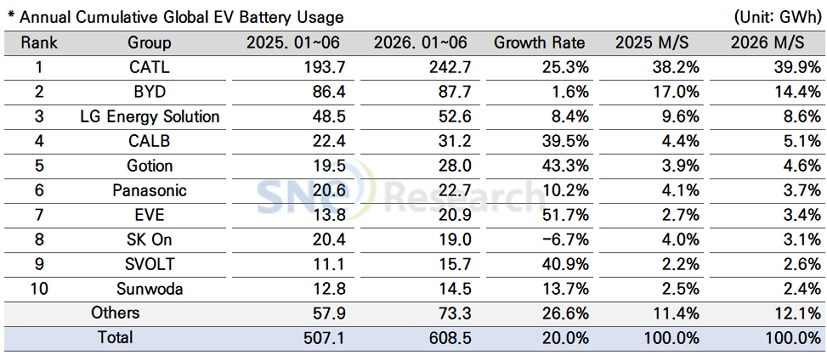
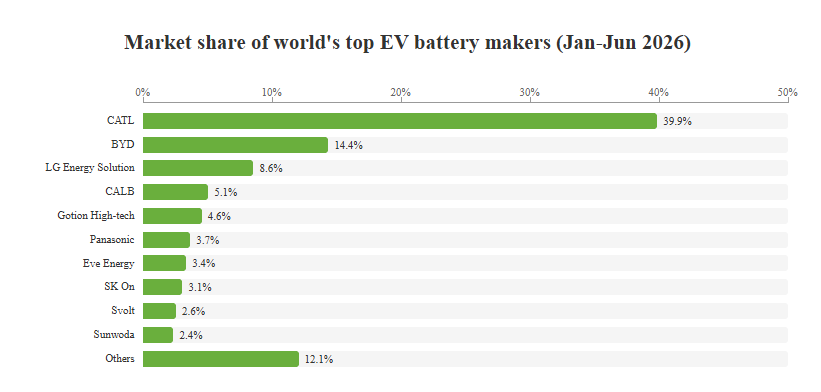
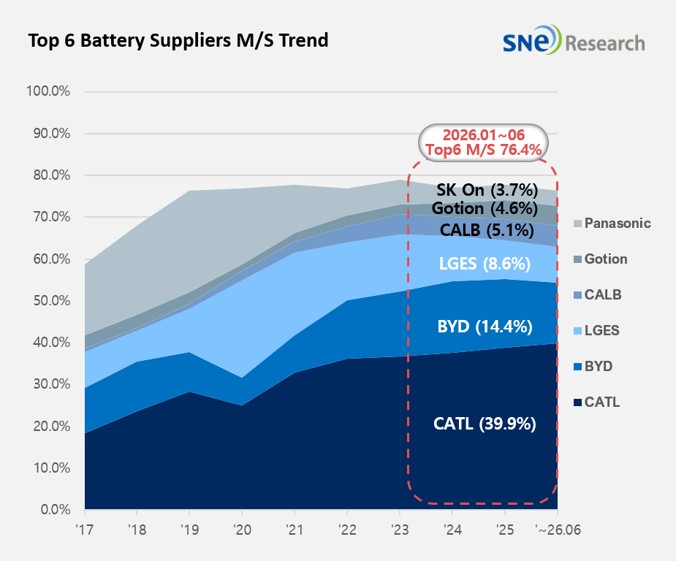
On August 5, South Korean research institution SNE Research released global electric vehicle battery usage data for the first half of 2026. Among the world’s top 10 power battery manufacturers, seven Chinese companies made the list, accounting for a combined market share of 72.4%, an increase of 1.5 percentage points compared with the same period last year.
Among them, Sunwoda replaced Samsung SDI and returned to the top 10 rankings. This marks the company’s comeback after dropping out of the TOP 10 list in 2025.
The industry leader remains CATL, which achieved a strong year-on-year growth of 25.3%, while increasing its market share by 1.7 percentage points. BYD maintained its second-place position, with a slight increase in battery installations, although its market share declined by 2.6 percentage points.
CALB, Gotion High-tech, EVE Energy, and SVOLT all achieved growth rates close to 40% year-on-year, with their market shares also increasing.
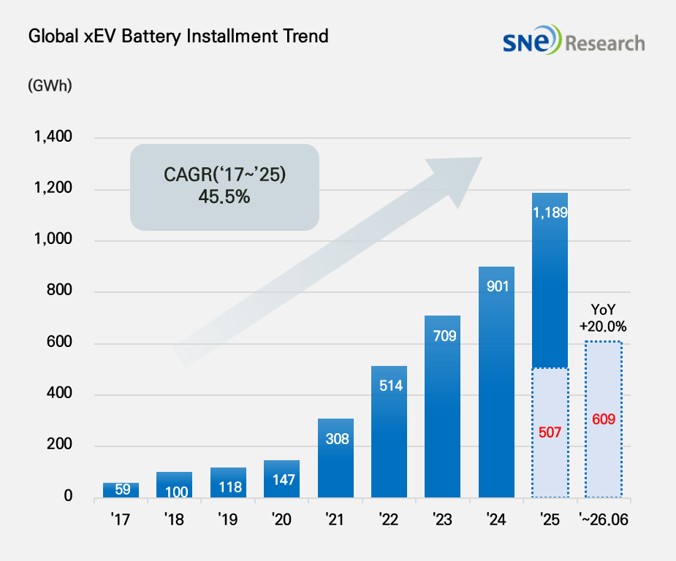
Looking at the overall market, global EV battery installations reached 608.5GWh from January to June, representing a year-on-year increase of 20.0%, maintaining rapid growth.
Chinese companies benefited the most from this expansion, while Korean manufacturers faced increasing pressure, causing the gap between Chinese and Korean battery suppliers to continue widening.
Chinese Battery Manufacturers: Strong in China, Strong Overseas
Entering 2026, China’s new energy vehicle market experienced a slowdown. Influenced by factors such as vehicle purchases being brought forward in 2025 and subsidy reductions, domestic NEV sales in the first half of the year reached 5.09 million units, down 13.4% year-on-year according to statistics from the China Association of Automobile Manufacturers (CAAM).
Despite the decline in vehicle sales, Chinese power battery manufacturers continued to grow, and their global market share increased by another 1.5 percentage points.
Looking first at the domestic market, although complete vehicle sales declined, power battery installations continued to increase.
According to data from the China Automotive Power Battery Industry Innovation Alliance, China’s cumulative power battery installation volume reached 335.6GWh from January to June, representing a year-on-year growth of 12.0%.
This growth was mainly driven by the increasing battery capacity installed per vehicle. In particular, range-extender EVs and plug-in hybrid vehicles have entered the era of larger battery packs.
According to the same organization, the average battery capacity per new energy vehicle in China has reached 69.1kWh, representing a year-on-year increase of 34.0%.
This growth completely offset the decline in vehicle sales, allowing total battery installation volume to continue increasing.
Looking at the global market, SNE Research also analyzed power battery installations outside China.
In markets excluding China, global EV battery installations reached 269.0GWh in the first half of the year, increasing 26.3% year-on-year, which was even faster than the growth rate in China.
However, Chinese battery manufacturers continued expanding rapidly in overseas markets. Despite facing certain trade barriers, Chinese companies still left limited room for competitors.
CATL remained the global leader. Its overseas battery installations reached 90.5GWh, representing a significant year-on-year increase of 41.7%. Its market share increased by 3.6 percentage points, rising from 30.0% to 33.6%.
According to SNE Research, CATL continues expanding supply partnerships with global automakers including Tesla, BMW, Mercedes-Benz, Toyota, and Kia. At the same time, the company supplies both overseas Chinese automakers and local international brands, forming a dual-customer structure across major markets in Europe and Asia, which has become a key growth driver.
Supported by the cost advantages of lithium iron phosphate (LFP) technology and a diversified product portfolio, CATL’s global expansion continues accelerating.
Chinese second-tier battery manufacturers including Gotion High-tech, SVOLT, CALB, and EVE Energy also achieved rapid growth:
- Gotion High-tech: 9.9GWh, up 141.5% year-on-year
- SVOLT: 8.4GWh, up 106.0% year-on-year
- CALB: 6.3GWh, up 80.5% year-on-year
- EVE Energy: 5.1GWh, up 171.5% year-on-year, the highest growth rate among major suppliers.
With Chinese automakers accelerating overseas expansion, these battery companies continue securing supply opportunities from European, Asian, and emerging-market automakers.
By combining LFP cost advantages with localized production and joint-venture strategies, Chinese battery suppliers are rapidly increasing their presence outside China.
BYD ranked third globally, with battery installations reaching 28.2GWh, an increase of 67.9% year-on-year. Its market share increased by 2.6 percentage points.
However, BYD’s growth mainly comes from the overseas expansion of its own vehicle sales. The Blade Battery’s competitive pricing and safety advantages provide strong support.
BYD is moving beyond relying solely on the Chinese domestic market. The company is expanding vehicle distribution networks and production facilities in Europe, Asia, and Latin America. Its overseas battery installation volume is expected to maintain strong growth momentum.
South Korean Battery Giants Decline, Samsung SDI Falls Out of the Top 10
The global power battery market has long been dominated by a “China-Japan-Korea competition.” However, as Chinese manufacturers continue to rise, Japanese and Korean suppliers are gradually losing ground.
In the first half of this year, among the three major South Korean battery companies, only LG Energy Solution maintained growth, while SK On declined and Samsung SDI experienced a significant drop.
After being surpassed by BYD in 2023, LG Energy Solution has remained in third place globally, but its market share has continued to decline.
In the first half of the year, LG Energy Solution recorded battery installations of 52.6GWh, an increase of 8.4% year-on-year. However, this growth rate was significantly lower than the overall market expansion, causing its market share to decline by 1 percentage point, from 9.6% to 8.6%.
LG Energy Solution has a strong customer portfolio, including major global automakers such as Tesla, Hyundai Motor Group, General Motors, and Volkswagen. However, not all of these automakers have experienced growth.
SK On recorded battery installations of 19.0GWh, down 6.7% year-on-year. Its market share declined from 4.0% to 3.1%.
SK On supplies batteries to automakers including Hyundai Motor Group, Ford, Volkswagen, and Mercedes-Benz. However, adjustments in EV sales and production plans among some customers in North America and Europe have limited the recovery of its battery installation volume.
Samsung SDI has fallen out of the global top 10 rankings.
SNE Research did not separately disclose Samsung SDI’s installation volume and market share in its global report. However, its non-China market report can serve as a reference, as Samsung SDI’s battery installations in China are negligible.
According to this measurement, Samsung SDI recorded battery installations of 10.5GWh, a sharp year-on-year decline of 29.0%, making it the largest decline among major battery manufacturers.
Its market share in markets outside China dropped from 7.0% to 3.9%.
According to SNE Research’s analysis, although Samsung SDI continues supplying batteries to major customers such as BMW, Audi, and Rivian, weak sales of Rivian models in North America and declining demand for older EV models from key European customers directly affected its installation volume.
The additional demand brought by new vehicle models was unable to offset the decline of existing major models.
The impact of the U.S. market on global battery installations can also be observed from the overall trend of global new energy vehicle sales.
Although China’s NEV market declined by 9.5% (according to SNE Research’s statistics, which differ from CAAM data), the North American market experienced an even larger decline of 20.5%.
Looking specifically at automakers, Tesla’s global sales increased by 16.3% in the first half of the year, but its sales are distributed worldwide.
In the U.S. domestic market, electric vehicle sales from General Motors, Ford, and Stellantis all dropped by around 50%. Rivian declined by more than 13%, while Lucid experienced a sharp decline of more than 32.4%.
Outside China and Korea, Japan’s Panasonic remains one of the leading global suppliers.
In the first half of the year, Panasonic ranked sixth globally, with battery installations of 22.7GWh, representing a year-on-year increase of 10.2%.
Panasonic has maintained its leading position for many years, mainly because of its close partnership with Tesla, whose sales growth in North America has supported Panasonic’s battery installation growth.
However, outside North America, Tesla relies more heavily on CATL and LG Energy Solution.
As a result, Panasonic’s growth rate has still lagged behind the overall market, with its market share declining from 4.1% to 3.7%.
Conclusion
The global power battery landscape in the first half of 2026 represents a continuation of the rise of Chinese battery manufacturers.
Whether in terms of domestic market scale, advantages in lithium iron phosphate (LFP) technology and cost competitiveness, or product iteration speed, Chinese companies continue to expand their global market share.
In the current generation of power battery technology, Chinese manufacturers have established a significant advantage.
German, American, Japanese, and Korean automakers once placed their hopes on solid-state batteries, expecting a technological revolution to reshape the competitive landscape.
However, Chinese battery companies and government authorities had already prepared for this possibility by investing heavily in solid-state battery research and development.
Based on current technological progress, a solid-state battery revolution may eventually occur. However, the leading position currently held by Chinese battery manufacturers is unlikely to be overturned in the near future.
Please explore our blog for the latest news and offers from the Chinese automotive market.