As Cars Become Smarter, Why Does the Brake Pedal Remain Critical to Safety?
When we talk about automotive technology today, we often think of environmental perception, intelligent algorithms, and autonomous driving. Yet the brake pedal beneath the driver’s foot, which is used every day, rarely takes center stage in these discussions. However, it performs an essential task: reliably communicating the driver’s intention to slow down to the braking system.
From traditional hydraulic braking to brake-by-wire technology, advances in engineering are changing how this command is transmitted. The importance of the brake pedal must therefore be understood in the context of the entire system.
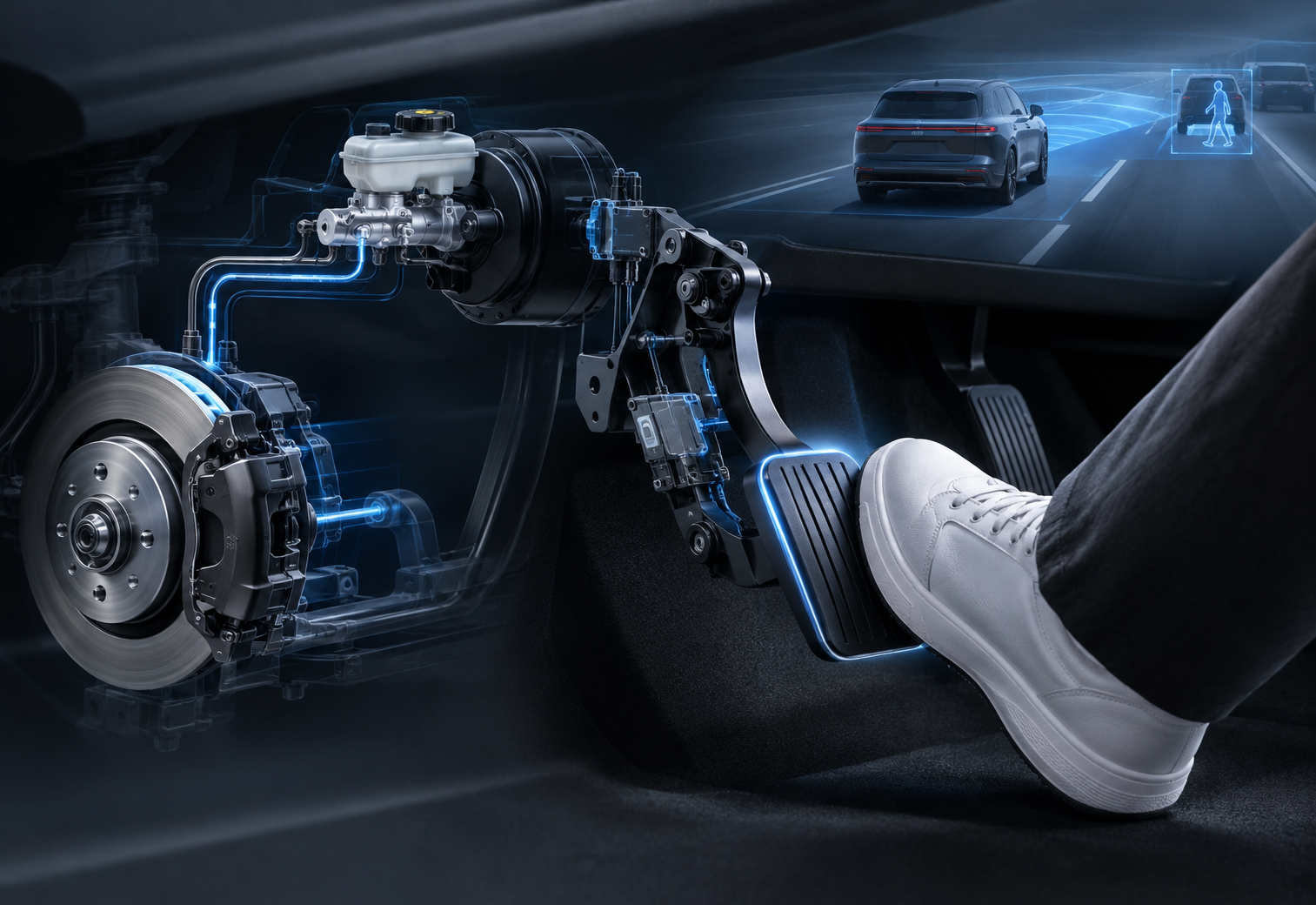
The Brake Pedal Is the Interface Between the Driver and the Braking System
In a common traditional hydraulic braking system, the driver presses the pedal, and the force is transmitted through the pedal mechanism and brake booster to the master cylinder, generating hydraulic pressure. The wheel brakes then produce braking force. Ultimately, the vehicle’s deceleration is also affected by factors such as tire grip and road surface conditions.
The pedal itself is not directly responsible for dissipating all the vehicle’s kinetic energy, but it is an essential interface through which the driver actively controls braking. A light press, a sustained press, or a rapid increase in pedal pressure communicates different braking demands. Drivers also rely on pedal travel and resistance to understand their inputs and adjust the force they apply.
Therefore, the brake pedal must not only be accessible and comfortable to operate, but also transmit braking demands accurately.

Reliability Depends on the Entire Brake Pedal Assembly
What we usually see is only the surface that comes into contact with the driver’s foot. Behind it, a typical brake pedal assembly includes a pedal arm, pivot shaft, bracket, connecting components, and a return mechanism. Some designs also integrate sensors and a pedal-feel simulation mechanism.
The force applied by the driver’s foot must travel along a carefully designed structural path. The bracket maintains the assembly’s mounting position, the pivot shaft constrains its movement, and the connecting components ensure that the individual parts work together.
If a critical structural component becomes loose, deformed, or damaged, the pedal’s movement and input may deviate from the original design.
However, two separate questions must be distinguished: whether the driver can still use the pedal to communicate a braking demand normally, and what other braking capabilities the vehicle retains. The latter depends on the specific architecture, the components affected, and the available backup pathways. It is not possible to reach the same conclusion for every vehicle based solely on the condition of a single component.
From an engineering perspective, brake pedal reliability requires consideration of materials, structural geometry, connection methods, manufacturing quality, and long-term use—not merely the appearance of the pedal surface.
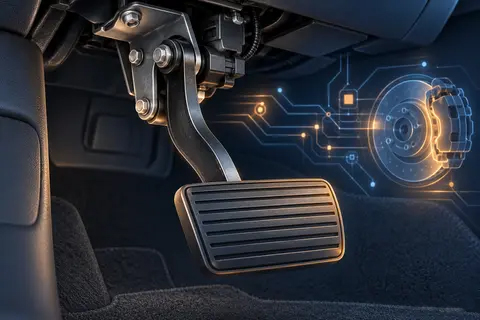
Brake-by-Wire Gives the Pedal a New Role
Brake-by-wire is an important technological direction in automotive electrification and intelligence. In some systems, sensors measure pedal travel or applied force, allowing the control system to determine the driver’s braking demand and then command the actuators to generate braking force. Different designs vary in how they incorporate mechanical connections, hydraulic backups, and electronic redundancy.
A 2023 study on electronic brake pedals identified sensor integration, functional safety, and reliability as important design considerations. For the driver, the action remains the same: pressing the brake pedal. Behind the scenes, however, the system may involve multiple stages, including signal acquisition, control processing, and actuator feedback.
These changes introduce new engineering challenges: How can sensor abnormalities be detected? How should power supply or communication failures be handled? How can the system ensure that the pedal feel remains understandable and predictable to the driver?
Electronics introduce additional controllable elements, making coordination between the mechanical structure, sensors, software, and actuators increasingly important. In designs that electronically detect pedal input, the signal transmission path differs from that of a traditional hydraulic system. The backup pathways of a specific vehicle must be evaluated separately.
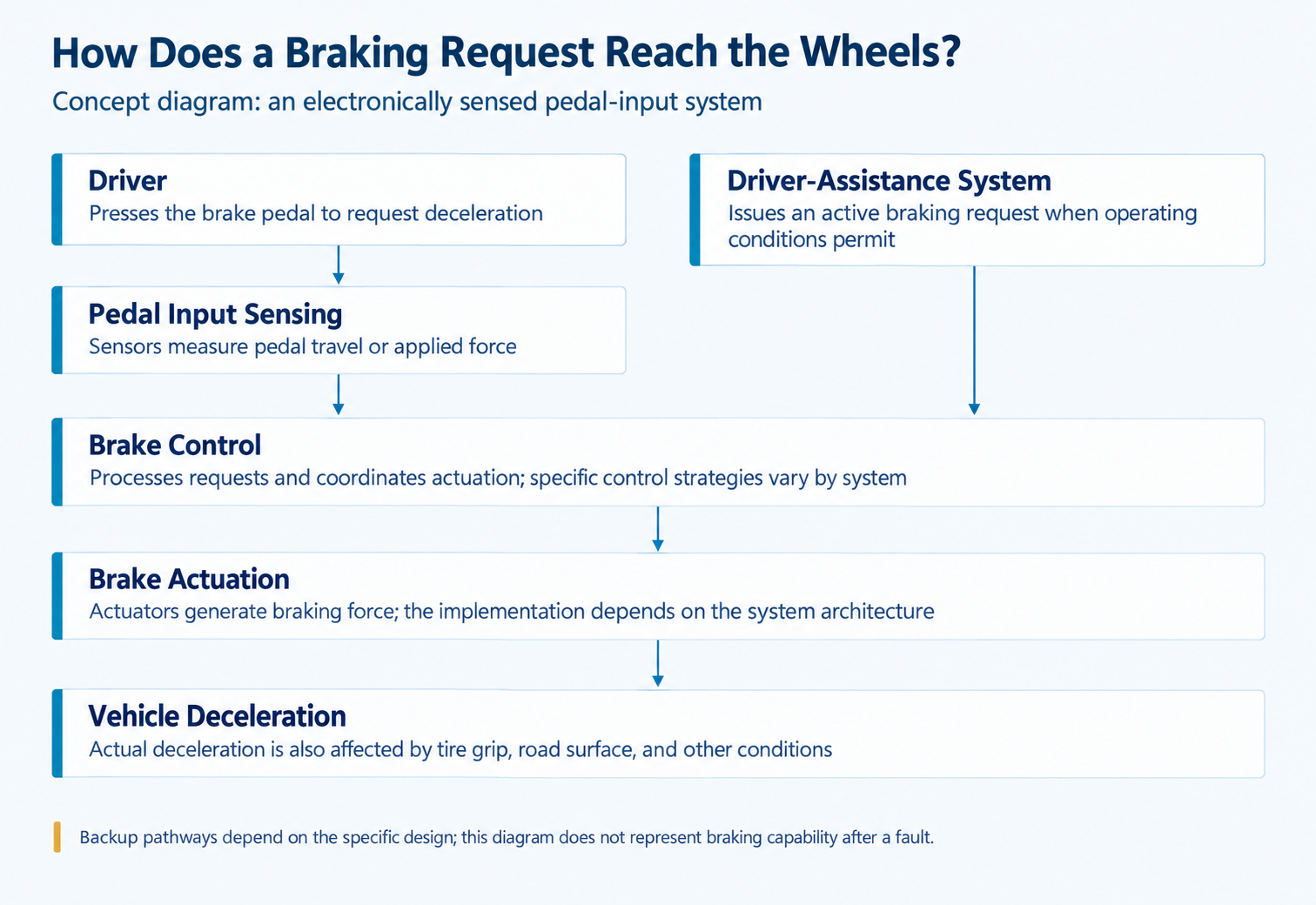
Automatic Emergency Braking Also Has Its Own Operating Limits
Automatic Emergency Braking (AEB) can use sensors to assess the risk of a potential collision ahead and, under certain conditions, apply the brakes automatically or compensate for insufficient braking input from the driver.
A vehicle can therefore have multiple sources of braking commands: the driver can request braking through the pedal, while a driver-assistance system may also issue an automatic braking request. However, the ability to brake autonomously does not, by itself, answer whether the vehicle can continue braking reliably after a particular brake pedal failure.
To answer the latter question, engineers must determine whether the fault affects shared sensing, power supply, control, or actuation components, and whether the system has been designed with specific countermeasures for that failure.
Redundancy means providing backup or alternative pathways based on an analysis of specific failure scenarios. Its effectiveness depends on which failures are covered, how independent the pathways are, and whether the transition between them meets safety requirements. A greater number of functions does not automatically mean that every possible failure has been addressed.

New Technologies Can Also Improve the Design of Fundamental Components
Designing a brake pedal involves far more than simply selecting a strong material.
Engineers can use simulation tools to analyze forces, identify areas of stress concentration, and compare different geometries. Physical testing can then verify structural strength, durability under repeated pedal operation, and the proper functioning of connections and return mechanisms.
Material selection and structural design must also be considered together. Even when using the same material, changing its thickness, shape, or connection method can produce different mechanical performance. A single static analysis cannot automatically demonstrate that a component will withstand every condition encountered throughout its service life.
Evaluating brake pedal reliability requires assessing the performance of the entire assembly under both expected operating conditions and relevant failure scenarios.
This is an important perspective to retain when examining advanced automotive technologies: software helps systems make decisions and coordinate their actions, while reliable hardware provides the physical foundation for those commands to be executed accurately.

In Intelligent Vehicles, Drivers Ultimately Need Predictable Feedback
From the moment a braking demand enters the system to the operation of the actuators and the vehicle’s actual deceleration, every stage must work together. The brake pedal sits at the starting point of the driver’s control pathway. Although it is not particularly conspicuous, it plays a crucial role in allowing the driver to communicate braking intentions smoothly and accurately.
As automotive technology becomes more sophisticated, it is increasingly important to explain these fundamental relationships clearly: Which functions are initiated by the driver? Which are initiated automatically by the vehicle? And what capabilities remain available when a fault occurs?
For drivers, the ideal technological experience is one in which every pedal input receives a timely, consistent, and predictable response. Achieving this level of reliability requires sound structural engineering, electronic control, and thorough validation.
Please explore our blog for the latest news and offers from the Chinese automotive market.